Dorqavelinix
Grid Concept
Grid Concept
Couldn't load pickup availability
- 📄 Digital file available after purchase
- 🗂️ Long-term availability
- 🔒 Secure checkout
- 🗓️ Content updated in 2026
Self-paced learning overview
Problem Statement
As databases expand, managing information within a single database structure can introduce new challenges. Increasing data volumes, concurrent operations, and changing storage requirements may influence database organization and performance.
Learners may understand relational models and query optimization but encounter difficulties when exploring distributed systems, partitioned datasets, and replicated information.
Another challenge involves understanding how architectural decisions influence consistency, availability, and coordination between different database components.
These topics require a broader view of how databases are structured and maintained.
Solution
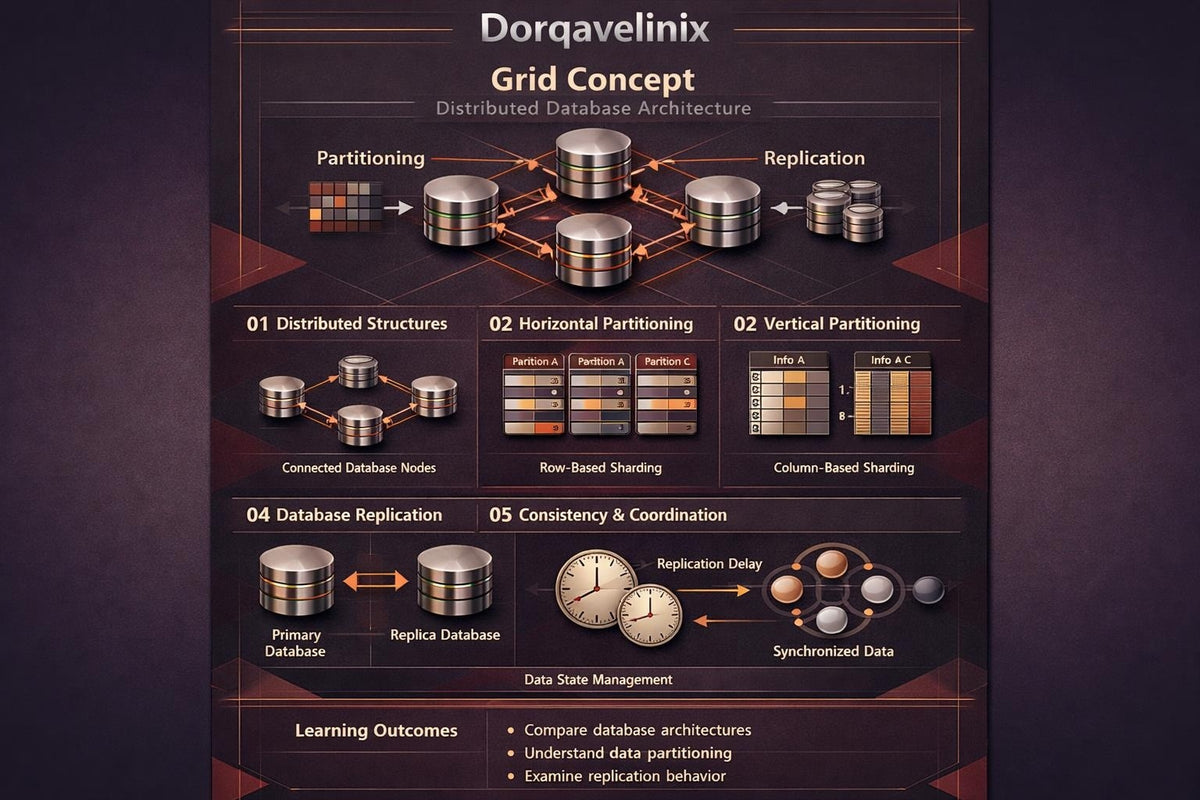
Grid Concept introduces a structured approach to database architecture and distributed data organization.
The course explains how database components interact, how data can be divided into partitions, and how replication supports different information management requirements.
Guided examples demonstrate architectural patterns, data distribution decisions, and common coordination challenges.
Learners examine practical scenarios involving distributed records, database connections, and system behavior during changes or interruptions.
What's Inside
- Introduction to database architecture
- Centralized and distributed database structures
- Data partitioning concepts
- Horizontal and vertical partitioning
- Introduction to database replication
- Primary-replica configurations
- Distributed data consistency
- Coordination between database components
- Data distribution and storage planning
- Introduction to database availability
- Handling database connection interruptions
- Architectural diagrams and design documentation
- Practical distributed database scenarios
- Certificate of completion
Who Is This For?
Grid Concept is intended for learners familiar with relational database design, indexing, transactions, and query performance analysis.
It is suitable for students and independent learners interested in database architecture, distributed information systems, and structured data management.
Previous knowledge of database relationships, transaction behavior, and indexing principles is recommended.
What You'll Learn
- Compare centralized and distributed database structures.
- Explain the purpose of data partitioning.
- Distinguish between horizontal and vertical partitioning.
- Describe common database replication approaches.
- Identify coordination challenges in distributed systems.
- Explain introductory consistency models.
- Examine how data distribution influences query processing.
- Recognize common replication delays and synchronization concerns.
- Interpret introductory database architecture diagrams.
- Evaluate architectural choices using structured scenarios.
- Document data distribution and storage design decisions.
Guarantee
14-Day Refund Policy: Eligible purchases may be refunded within 14 days, according to the store's published refund policy and applicable conditions.
Purchase Information: Learners can review the course description, included materials, and refund conditions before purchasing. Refund requests are evaluated according to the published policy.
Share
Are the courses provided as PDF files or separate modules?
Are the courses provided as PDF files or separate modules?
Our courses are designed as downloadable digital learning materials organized into structured sections and modules. Learners can follow the topics in sequence or revisit individual sections during independent study.
The individual course page provides information about its included materials and file format.
What exactly is included in Dorqavelinix courses?
What exactly is included in Dorqavelinix courses?
Each Dorqavelinix course includes structured educational materials focused on specific database topics. Depending on the selected tier, materials may cover relational database design, query construction, data integrity, transactions, indexing, distributed architecture, and recovery planning.
Courses contain explanations, practical examples, guided activities, and review sections. Each tier also includes a certificate of completion.