Dorqavelinix
Cipher Archive
Cipher Archive
Couldn't load pickup availability
- 📄 Digital file available after purchase
- 🗂️ Long-term availability
- 🔒 Secure checkout
- 🗓️ Content updated in 2026
Self-paced learning overview
Problem Statement
As databases contain larger datasets and more detailed relationships, queries may require additional processing resources. Statements that work well with smaller datasets can behave differently when table sizes increase or multiple operations occur simultaneously.
Learners may understand query syntax but find it difficult to explain why certain queries require more processing time than others.
Another challenge involves understanding how indexes influence data retrieval, how database engines evaluate query conditions, and why different execution strategies produce different results.
These topics require careful examination of database structures and query behavior.
Solution
Cipher Archive introduces a structured approach to database indexing and query performance analysis.
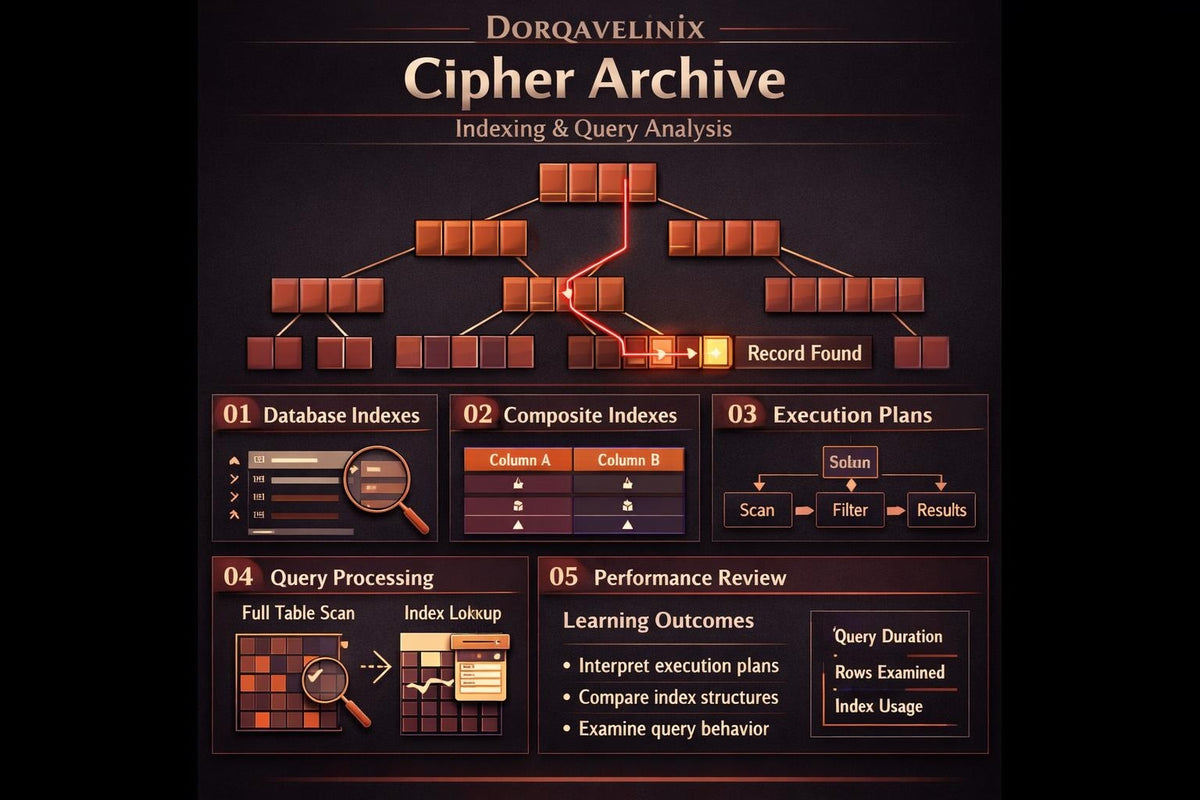
The course explains how indexes organize references to stored records, how query execution plans describe database operations, and how different query structures influence processing requirements.
Guided exercises demonstrate index selection, query comparison, execution plan interpretation, and introductory performance measurements.
Learners also examine the relationship between indexing decisions, storage requirements, and data modification operations.
What's Inside
- Introduction to database performance concepts
- Database indexing principles
- Common index structures and their purposes
- Single-column and composite indexes
- Index selectivity and column ordering
- Query execution plans
- Table scans and index scans
- Query filtering and join performance
- Introduction to query optimization
- Index maintenance and storage considerations
- Measuring query execution behavior
- Comparing alternative query structures
- Practical indexing and analysis exercises
- Certificate of completion
Who Is This For?
Cipher Archive is intended for learners familiar with relational databases, structured queries, joins, and database transactions.
It is suitable for students and independent learners interested in understanding database indexing, query execution, and performance analysis.
Previous experience with relational database design and query construction is recommended.
What You'll Learn
- Explain the purpose of database indexes.
- Distinguish between common indexing structures.
- Identify situations where composite indexes may be useful.
- Describe how column ordering influences index behavior.
- Interpret introductory query execution plans.
- Recognize table scans and index-based retrieval operations.
- Compare different query execution approaches.
- Examine how filtering conditions influence query processing.
- Explain the relationship between indexes and data modification.
- Identify storage and maintenance considerations associated with indexing.
- Measure and compare query behavior using sample datasets.
- Document observations from database performance exercises.
Guarantee
14-Day Refund Policy: Eligible purchases may be refunded within 14 days, according to the store's published refund policy and applicable conditions.
Purchase Information: Learners can review the course description, included materials, and refund conditions before purchasing. Refund requests are evaluated according to the published policy.
Share
Are the courses provided as PDF files or separate modules?
Are the courses provided as PDF files or separate modules?
Our courses are designed as downloadable digital learning materials organized into structured sections and modules. Learners can follow the topics in sequence or revisit individual sections during independent study.
The individual course page provides information about its included materials and file format.
What exactly is included in Dorqavelinix courses?
What exactly is included in Dorqavelinix courses?
Each Dorqavelinix course includes structured educational materials focused on specific database topics. Depending on the selected tier, materials may cover relational database design, query construction, data integrity, transactions, indexing, distributed architecture, and recovery planning.
Courses contain explanations, practical examples, guided activities, and review sections. Each tier also includes a certificate of completion.